





One of the idioms that they teach in school is that “experience is the best teacher”. In my case, experience has been my only teacher. Everything that I do for a living, I have learnt only from experience, coupled with determination and hard work.
Going to Gwalior was not an arbitrary choice. A friend’s father had suggested I consider Gwalior when I had shared my dream of becoming a tailor. He provided me with a reference of a tailor based there, named Salvi, and I arranged to meet him soon after my arrival in Gwalior. Salvi offered me an accommodation and a job of stitching suits, something in which I was already quite skilled. Through this job, I met a gentleman named Mishra, to whom I was introduced by an acquaintance. With him, I embarked on my first major venture: a ready-made shirt business. I showed Mishra some styles that he liked. Hence we came on board to start a venture. He had also taken down my Nagpur address.
Mishra found a location in Morar, Gwalior district, while I sought employment with various tailors – identifying and recruiting skilled workers from each establishment. I then proposed to Mishra that we source fabric from the Empress Mill in Nagpur, which is renowned for its quality. He agreed, and I returned to my hometown. However, I did not visit anyone at home. Instead, I completed my tasks at the Mill before heading back to Gwalior.
Over the next few weeks, we worked hard on setting up our business. When we started our venture, 10-12 people were working for it. My job was to source fabric and deliver the shirts. I was in charge of production and marketing, and travelled all over the country with samples from our factory, working and learning at the same time. I set up working arrangements with dealers in cities such as Nagpur, Amravati, and Calcutta (now Kolkata), and returned with bulk orders. We immediately got to work and started delivering within the given deadlines. Disaster, however, struck soon.
Our dealer in Calcutta informed us that he had not received a large order that he had placed with us. The order was valued at approximately Rs 1.25 lakh, a significant sum in those days. I was confident that I had managed everything correctly on my end, but the dealer insisted that the order had never arrived. Mishra was furious with me; nothing I said could convince him that there had been no error on my part.
In hindsight, I do not blame him, as he had invested his own money in the venture and was also paying me a salary. However, I disagreed with the manner in which he turned against me. He went to the extent of harassing my family members, who were unaware of my work at that time. Ultimately, I decided it was best to move on and resign from my position.
Till early 1969, I was in Gwalior. The stint in Gwalior taught me that I had a lot to learn about tailoring, and I decided to travel all around the country to do so. After the fallout with Mishra, I was in Delhi for six months where I worked at Sarpal Tailor in Daryaganj. After that, I went to Moradabad, Rampur, Aligarh, Lucknow, and Kanpur.
From Gwalior, I first went to Delhi, where I spent around six months working with a tailor named Sarpal – one of the biggest tailors of his time. While working at the factory in Gwalior, I had heard the other tailors talk about how Moradabadi sherwanis were the most in demand, so I visited Moradabad after spending six months in Delhi, where I learnt how to make sherwanis. During that same time, someone had also told me that the best men’s pyjamas were made in Aligarh. Therefore, after I made sure that I had learnt everything about Moradabadi sherwanis, I packed up my meagre belongings and moved to Aligarh.
After completing my stint in Aligarh, Uttar Pradesh, I worked at Rourkela, Cuttack, and other parts of Orissa (now Odisha), Mahu, Jodhpur, Bhilai, and Calcutta. Knowing English and coming from a good family helped me gain people’s trust to share their skills with me. I must have stayed for around six months at each place before coming to Bombay (now Mumbai) in 1973. Everywhere I went, I would use whatever space was available in the shop or factory to sleep. My days would be spent working and learning simultaneously. Every bit of information I gathered was filed away in my head, not just knowledge of tailoring, but also tips on how to deal with people.
I learnt early on in life that to gain what you need, you have to be able to handle people well. I identified the likes and dislikes of the tailors in each city I went to, and used that to gain their trust or favour. This journey enriched my life, both professionally and personally. These experiences and learnings helped me grow when I eventually came to Bombay. Despite being a teetotaller, I would buy liquor for the established local tailors and loosen their tongues. Despite never having touched meat in my life, I would treat the tailors to the choicest non-vegetarian meals that I could afford. I never said no to an assignment, no matter how overworked I was, and always made it a point to deliver every order without compromising on quality or missing a deadline.
They say that in the land of the blind, the one-eyed man is king. This was another adage that proved true for me during my years of self-education. I stood out as an English speaker in a sea of mostly regional-language-speaking tailors! They would employ me to manage the counter and pepper my spiel with English words to reel in customers. The skills that I developed during my years managing the counter would ultimately prove to be a huge blessing.
Coat-making was a highly sought-after skill at the time, and the fact that I could create a perfect coat despite being extremely young was another thing that worked in my favour. This proficiency automatically enhanced my value as an employee, as it meant that there was one less skill for my employer to teach me – and a significant one at that!
Wherever I went, I diligently mastered the intricacies of the local specialities. In Mahu and Jodhpur, I learnt to make garments for military servicemen – an additional skill that would prove beneficial. I also realised that if you understood the fundamentals of tailoring, it was simply a matter of grasping the differences between various styles. Once I clarified this in my mind, the rest became relatively straightforward.
While I was exploring my options, I also visited Bombay during this time for a short while, but didn’t do any tailoring work then. Instead, I experimented with the business side of the industry and tried my hand at selling tailoring goods. The business didn’t do well, but it taught me that my real skill lay in making clothes, not in selling the goods connected to them. I then went back to full-fledged tailoring and ultimately ended up in Calcutta.
Like Bombay, my experience in Calcutta was bittersweet – I lost something but also gained something in return. After reaching there, the first thing I did was visit the dealer who had cheated Mishra and me while we were working together in Gwalior. Driven by a misguided sense of righteousness, I confronted him at his shop, hoping to elicit the truth. Instead, he insulted me and told me to leave. I was furious, but I realised that I couldn’t afford to pick a fight on his own turf.
This realisation prompted me to seek employment in Calcutta. I resolved to rise to fame and influence through hard work and dedication. I joined an international company (L Messy), returning to the basics as a cutter. I quickly learnt that knowing Bengali was essential for survival in the city, so I picked it up. I had no idea at the time, but this skill would become an important stepping stone in my journey to success.
However, tragedy was not far behind. Kolkata was then engulfed in the Naxalite conflict, and within a couple of months, the shop where I worked was burned down by Naxals. Frustrated, I watched as the owner packed up and left the country.
A local tailor, having heard that I had spent some time in Bombay, asked if I had ever stitched clothes for the film industry. Although I had not, I lied and claimed that I had made outfits for Bollywood stars like Dev Anand and Pran. The tailor believed me, but the lie gnawed at my conscience. I realised there was an entirely new world waiting to be discovered – the world of film costume design.
With my mind made up, I packed my bags once more, bid farewell to Calcutta, and set off for Bombay – a decision that would change my life forever! Eventually, the strong relationships that I later developed in Bollywood became a form of social capital.
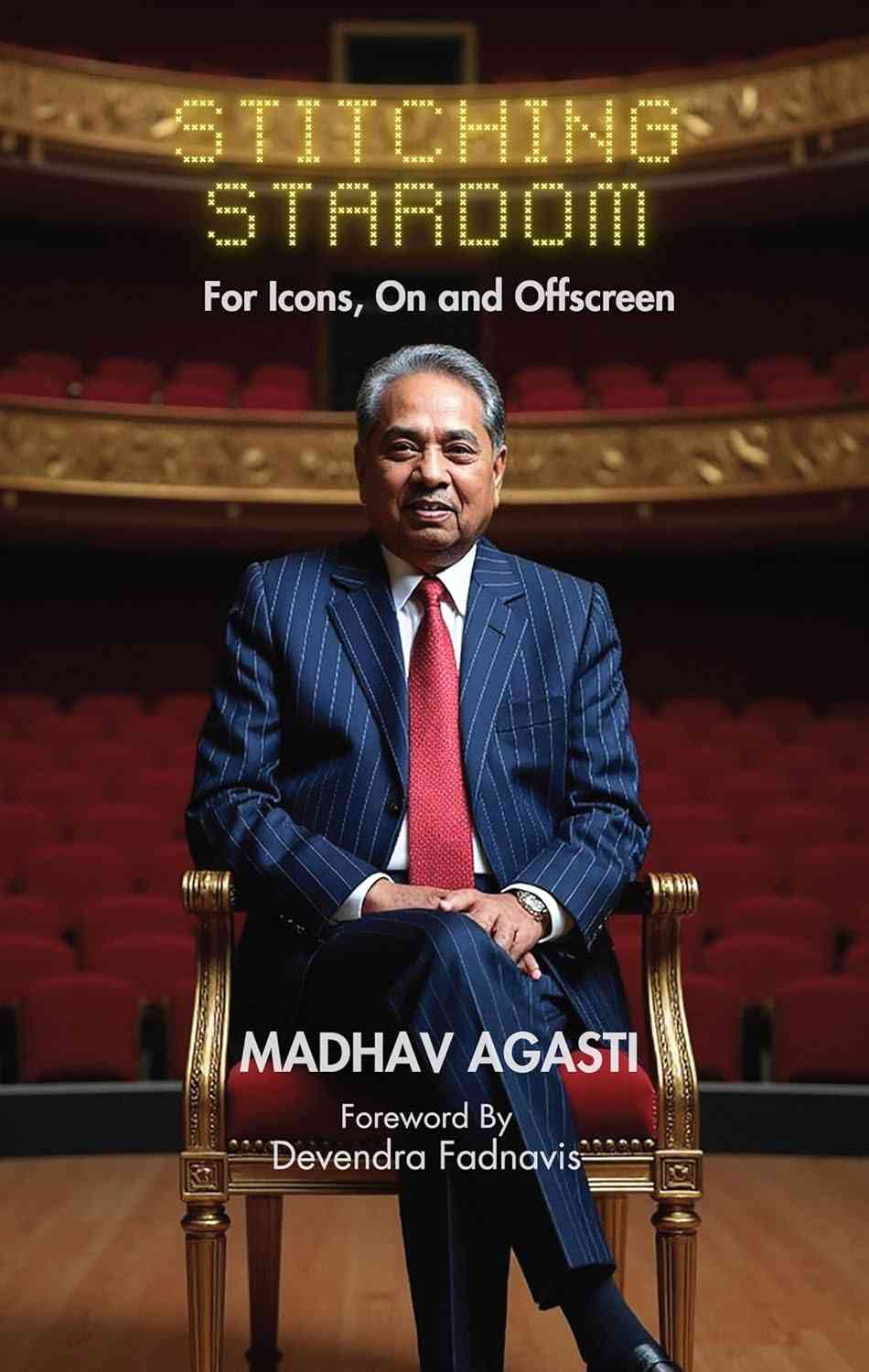
Excerpted with permission from Stitching Stardom: For Icons, On and Offscreen, Madhav Agasti, Penguin Enterprise.
